Crop Improvement Consortium

The Crop Improvement Consortium (CIC) is focused on ensuring that high yielding, locally adapted crop varieties are available in South Africa.

  1. Home
  2. Research, Agronomy & Innovation
  3. Crop Improvement Consortium

The consortium was initially established to address a pivotal challenge in South Africa’s wheat industry. Wheat is a staple crop in South Africa, yet the country produces only about half of its total wheat needs, making it heavily dependent on imports. This poses a significant threat to food security, highlighting the urgent need for high-yielding, locally adapted wheat varieties.

Historically, South Africa’s wheat breeding programs prioritised quality over yield, leading to the loss of high-yielding varieties that could have boosted production. Additionally, high-yielding wheat varieties from other parts of the world have struggled to perform under South Africa’s unique agro-climatic conditions. Therefore, the CIC was established to directly address these challenges by developing locally adapted, high-yielding wheat germplasm, ensuring that South Africa’s grain industry can thrive.

Our Aim

Provide industry access to improved genetics and higher yielding, locally adapted germplasm to enhance the sustainability of the industry and improve South Africa’s self-sufficiency.

Our focus areas

  • Develop pre-breeding programmes which can respond to evolving needs of producers and markets.
  • Distribute high-yielding germplasm to breeding programmes on an annual basis.
  • Build international and public-private partnerships to build capacity and enhance accessibility to global gene banks.

Objectives

OBJECTIVE 1

Develop pre-breeding and breeding programmes which can respond to evolving needs of producers and markets.

This objective focuses on building robust breeding pipelines that can deliver wheat varieties adapted to changing climatic conditions, production constraints, and market requirements.

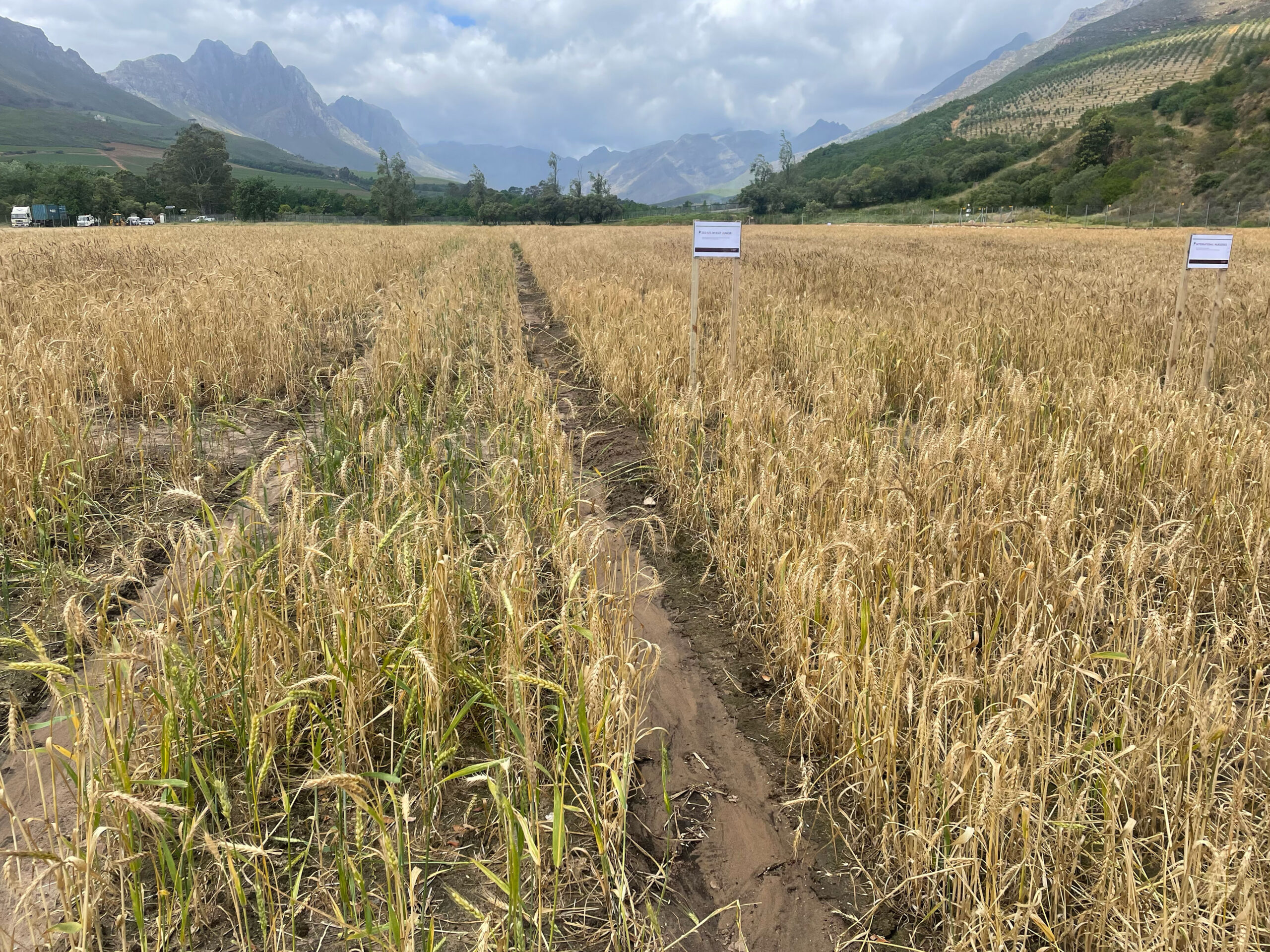
To deliver wheat varieties that are more resilient, productive, and aligned with market and producer demands, significant progress has been made in strengthening both pre-breeding and breeding pipelines. Between 2021 and 2024, over 7000 single rows and 2000 plots were screened across the field trial sites to evaluate local and international wheat accessions. This effort focused on identifying high-performing germplasm with adaptability, yield potential, and resistance to production constraints such as drought and disease.

A key activity under this objective involved characterising Wheat Crop Wild Relatives (CWRs). Wheat Crop Wild Relatives are the undomesticated species that are genetically related to cultivated wheat, particularly from the Triticum and Aegilops genera. These wild species have evolved in diverse environments and often retain valuable traits that have been lost in modern wheat varieties, such as salt tolerance, floral fertility, and the ability to cross with cultivated lines. A total of 112 entries from 19 species were characterised using internationally recognised descriptors, with two Triticum turgidum accessions showing strong potential as crossing parents. Additional work explored local wild species like Thinopyrum distichum and Secale strictum subsp. africanum, revealing further valuable traits and broadening the diversity available for wheat breeding. This work has laid a solid foundation for incorporating new resilience traits into South African wheat varieties.

Breeding activities have been advanced through targeted crossing programmes, which used an innovative MS-MARS system to develop and evaluate hybrid lines. Promising lines have progressed to yield trials, with some outperforming commercial cultivars. Marker-assisted selection further improved breeding precision by applying standardised molecular markers and KASP technology to traits like yield and disease resistance. practical application was ensured through the distribution of promising germplasm, with 796 high-potential genotypes shared with Syngenta, Corteva, and ARC-SG since 2021. In 2024, selected genotypes were packaged for machine sowing and evaluation, bringing the programme closer to delivering improved, locally adapted cultivars that respond directly to evolving producer and market needs. 

OBJECTIVE 2

Develop international and public-private partnerships to expand access to global gene banks and genomic platforms.

This objective aims to strengthen collaboration with global research entities and industry partners to improve access to elite germplasm, genomic tools, and advanced breeding technologies.

To strengthen breeding capacity and innovation, the Wheat Breeding Platform (WBP) has pursued strategic collaborations across both public and private sectors. Key engagements included active participation in events such as the SAPBA Symposium, SANSOR Congress, and Combined Congress, where researchers received recognition and contributed to national dialogue through awards and committee roles.

International cooperation has been advanced through collaboration with the International Maize and Wheat Improvement Centre (CIMMYT), which provided elite germplasm from its global spring wheat programme for local testing and evaluation. This directly enhances access to valuable international genetic resources.

The platform also expanded private-sector engagement. Discussions led by Grain SA with BioCeres explored the potential integration of heat and drought tolerance traits into local breeding pipelines. Meanwhile, the Wheat Breeding and Crossing Programme distributed MS-MARS evaluation nurseries to institutions including Syngenta, Corteva, and ARC-SG, enabling shared evaluation and application of advanced selection tools. These partnerships continue to strengthen South Africa’s access to global resources and drive forward collaborative wheat improvement.

OBJECTIVE 3

Develop high-yielding germplasm which are distributed to breeding programmes on an annual basis.

A core function of the platform is to provide new and improved wheat germplasm consistently.

Each year, the Wheat Breeding Platform (WBP) delivers elite wheat lines to breeding partners, supporting the development of cultivars with better yield, adaptability, and resilience.

Under the Wheat Breeding and Crossing Programme, the MS-MARS system has generated promising new lines that have undergone rigorous screening and selection. Many of these have shown superior performance compared to existing commercial varieties. This progress feeds directly into germplasm distribution efforts, which coordinate the annual release of high-potential wheat genotypes to breeding programmes. Since 2021, a total of 796 genotypes have been shared, supporting the breeding pipelines of Syngenta, Corteva, and ARC-SG. The 2024 distributions prioritised genotypes with strong yield traits, packaged specifically for mechanised sowing and yield evaluation trials. This systematic and ongoing dissemination of elite material directly supports breeding programmes in developing cultivars with improved performance and adaptability.

Objectives

OBJECTIVE 1

Develop pre-breeding and breeding programmes which can respond to evolving needs of producers and markets.

This objective focuses on building robust breeding pipelines that can deliver wheat varieties adapted to changing climatic conditions, production constraints, and market requirements.

To deliver wheat varieties that are more resilient, productive, and aligned with market and producer demands, significant progress has been made in strengthening both pre-breeding and breeding pipelines. Between 2021 and 2024, over 7000 single rows and 2000 plots were screened across the field trial sites to evaluate local and international wheat accessions. This effort focused on identifying high-performing germplasm with adaptability, yield potential, and resistance to production constraints such as drought and disease.

A key activity under this objective involved characterising Wheat Crop Wild Relatives (CWRs). Wheat Crop Wild Relatives are the undomesticated species that are genetically related to cultivated wheat, particularly from the Triticum and Aegilops genera. These wild species have evolved in diverse environments and often retain valuable traits that have been lost in modern wheat varieties, such as salt tolerance, floral fertility, and the ability to cross with cultivated lines. A total of 112 entries from 19 species were characterised using internationally recognised descriptors, with two Triticum turgidum accessions showing strong potential as crossing parents. Additional work explored local wild species like Thinopyrum distichum and Secale strictum subsp. africanum, revealing further valuable traits and broadening the diversity available for wheat breeding. This work has laid a solid foundation for incorporating new resilience traits into South African wheat varieties.

Breeding activities have been advanced through targeted crossing programmes, which used an innovative MS-MARS system to develop and evaluate hybrid lines. Promising lines have progressed to yield trials, with some outperforming commercial cultivars. Marker-assisted selection further improved breeding precision by applying standardised molecular markers and KASP technology to traits like yield and disease resistance. practical application was ensured through the distribution of promising germplasm, with 796 high-potential genotypes shared with Syngenta, Corteva, and ARC-SG since 2021. In 2024, selected genotypes were packaged for machine sowing and evaluation, bringing the programme closer to delivering improved, locally adapted cultivars that respond directly to evolving producer and market needs. 

OBJECTIVE 2

Develop international and public-private partnerships to expand access to global gene banks and genomic platforms.

This objective aims to strengthen collaboration with global research entities and industry partners to improve access to elite germplasm, genomic tools, and advanced breeding technologies.

To strengthen breeding capacity and innovation, the Wheat Breeding Platform (WBP) has pursued strategic collaborations across both public and private sectors. Key engagements included active participation in events such as the SAPBA Symposium, SANSOR Congress, and Combined Congress, where researchers received recognition and contributed to national dialogue through awards and committee roles.

International cooperation has been advanced through collaboration with the International Maize and Wheat Improvement Centre (CIMMYT), which provided elite germplasm from its global spring wheat programme for local testing and evaluation. This directly enhances access to valuable international genetic resources.

The platform also expanded private-sector engagement. Discussions led by Grain SA with BioCeres explored the potential integration of heat and drought tolerance traits into local breeding pipelines. Meanwhile, the Wheat Breeding and Crossing Programme distributed MS-MARS evaluation nurseries to institutions including Syngenta, Corteva, and ARC-SG, enabling shared evaluation and application of advanced selection tools. These partnerships continue to strengthen South Africa’s access to global resources and drive forward collaborative wheat improvement.

OBJECTIVE 3

Develop high-yielding germplasm which are distributed to breeding programmes on an annual basis.

A core function of the platform is to provide new and improved wheat germplasm consistently.

Each year, the Wheat Breeding Platform (WBP) delivers elite wheat lines to breeding partners, supporting the development of cultivars with better yield, adaptability, and resilience.

Under the Wheat Breeding and Crossing Programme, the MS-MARS system has generated promising new lines that have undergone rigorous screening and selection. Many of these have shown superior performance compared to existing commercial varieties. This progress feeds directly into germplasm distribution efforts, which coordinate the annual release of high-potential wheat genotypes to breeding programmes. Since 2021, a total of 796 genotypes have been shared, supporting the breeding pipelines of Syngenta, Corteva, and ARC-SG. The 2024 distributions prioritised genotypes with strong yield traits, packaged specifically for mechanised sowing and yield evaluation trials. This systematic and ongoing dissemination of elite material directly supports breeding programmes in developing cultivars with improved performance and adaptability.

Projects

CURRENT PROJECT

Wheat Breeding Platform

Primary Institution: Stellenbosch University 

Principal Investigators: Willem Botes, Lezaan Hess & Cecile Bester

Collaborators: ARC-SG: V Tolmay, K Coetzee, and IC Heyns  

Syngenta: F Koekemoer, S De Groot, and D Lesch  

CURRENT PROJECT

Preharvest Sprouting of South African wheat cultivars

Primary Institution: Stellenbosch University 

Principal Investigators: Prof Pieter Swanepoel 

Collaborators: Stellenbosch University, University of Fort Hare, Western Cape Department of Agriculture 

Stakeholders

Scroll to Top